













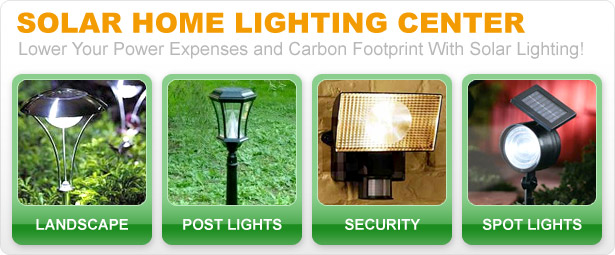
Solar landscape lighting is actually simpler to install than a traditional wired light setup. One of the biggest advantages is that each lighting unit is self contained, so you don't have to run wiring back into your house or call to have the buried cables in your yard marked. Since they are competitively priced with traditional models, there is no reason to opt for the more complex, harder to maintain system of grid-fed lights. Solar sign lights are useful for exactly what their name implies. The solar panel builds a charge during the day, and when the light falls below a certain threshold it switches the light on, illuminating your sign without adding a cent to your power bill after it is installed. Current models keep the light on throughout even winter nights. 
Solar LightingSolar lighting is a great solution for homeowners looking to cut down on their daily electricity costs. It is also an ideal solution for providing light for sheds, gazebos, cabins, outhouses, back garages, and other locations that are not connected to the electrical grid. The freedom to install lighting independently of a convenient grid connection really opens up new avenues for the lighting. It can even be an energy savvy choice for places located on-grid as the lights won't add to your utility bills when you run them. One great benefit of solar indoor lighting is that it is low maintenance and very easy to install. The only requirement is a good spot to mount the solar panel. To ensure that the panel receives the most possible sunlight it should be mounted on a south-facing slope for locations in the northern hemisphere. If a due south facing is impractical you can swing up to thirty degrees off from due south without significant productivity losses. The panel's location should be in open sun for as much of the day as possible, and out of the shade of trees or other buildings. While indoor solar lighting is not as prevalent as its outdoor cousin, switching to it is a natural step to take after trying outdoor solar lighting. The applications for indoor use are surprisingly varied. Instead of path lighting, you can install low wattage bulbs into your dining room to enhance the ambiance for dinner. Instead of an exterior security light, you can install interior security lights, or even modify the array and batteries to run motion sensors or other security equipment. Purchasing solar powered lights for the indoors is not just an investment in energy-efficient lights for your home, it is also an investment in the environment. Solar power is an excellent way to create a more environmentally-friendly home. Grid supplied power in the US is more than sixty percent derived from fossil fuel plants. These plants emit hundreds of millions of tons of carbon monoxide and other harmful chemicals into the atmosphere each year. As if that weren't enough, they run on a finite resource that is rapidly being consumed. One day, the fossil fuels will simply be gone, and we lack the technology to readily produce more. Solar power, by comparison, runs on the sunlight our earth already receives. The sheer quantity of sunlight the Earth is showered with each day is staggering. In a single hour, the planet takes in enough energy to meet the demand for an entire year. The vast majority of this energy goes unused by us, with less than ten percent of the current global production stemming from solar power. Installing solar indoor lighting will also save a lot of money down the road. The initial fees can be daunting to some. However, the money saved on the electricity bill will pay for the lighting in time. This fact, in addition to it being easy to install and easy to maintain, leaves few, if any, buyers regretting solar indoor lighting. Solar Outdoor Lighting Residential Solar Lighting Sky Lights Solar Lamp Post Solar Landscape Lights Solar Lights Solar Outdoor Lights Solar Patio Lights Solar Address Light Solar Power Rope Light Solar Powered Lights Solar Powered Outdoor Lighting Solar Spot Lights Solar Step Lights Solar Street Lights Solar Yard Lights Commercial solar lighting Hybrid Solar Lighting Making Progress Solar Lighting Resources: Learning Center | Lighting Info | Lighting Center | Solar Lighting Self Evaluation | Outdoor Solar Lighting | Indoor Solar Lighting | Ambient | Critical | Non Critical Browse Other Solar Information by Category: Solar Learning Center | Fans and Heaters | Home Accessories | Outdoor Products | Solar Energy Systems and Parts | Water and Pools 

 |
     |
   Copyright © 1998 - 2010 All Rights Reserved
|